Longtime local journalist Bill Radford and his wife, Margaret, live on 5 acres in the Falcon area with chickens, rabbits, dogs, cats, a flock of parakeets, goats, two horses and two ducks. Contact Bill at billradford3@gmail.com.
Tracking chickens
By Bill Radford
We are in the midst of Project Chicken ID.
The idea: to snap a photo of each of our chickens and put in a scrapbook or something, along with a history of each chicken if we can.
How many chickens? Somewhere around 30, but is it exactly 30, or is it 29, as I counted the other day? With chickens at any point in the day resting in their house, roaming their pen, jumping over into the side yard, etc., it is hard to get a precise count. Which is one reason for Project Chicken ID. If we were missing a chicken, we wouldn’t necessarily know. For example, we found a bunch of chicken feathers in the barn the other day. Did a chicken make it all the way to the barn, only to meet a grim fate?
There are some chickens that I would certainly notice if they were gone, especially the few with names.
There is Grandpa, the rooster I have written about before, who now has his own quarters after our younger roosters started beating him up or chasing him away, pushing him to the bottom of the pecking order. A couple of hens live with him; both were given to us by a neighbor when she moved and had to relinquish her flock. One is an older, red, no-name hen. The other is Thumbelina, so named because of her diminutive size. She also has another distinctive feature: no toes. She lost them to frostbite before she came to us, but she still gets around fine and can still perch on a roost.
There’s also Betty, which my wife, Margaret, named after an old friend. (Whether that friend would view that as an honor, I can’t say). Betty is a copper maran, a breed known for laying dark, chocolate-colored eggs. We have several copper marans; while they look alike, we can tell Betty from the pink band on her right leg. We got Betty from a woman who has sold us several hens; in this case, she gave us Betty to see if we could nurse her back to health. She was suffering from a respiratory disease and some in her flock had died of it. With a visit to the chicken vet, medicine and a lengthy period in quarantine, Betty did survive and is now part of the flock.
We also have Lurch, named after the hulking character in “The Addams Family.” Like that Lurch, our Lurch towers over most of her fellow chickens. She’s at least part shamo, a Japanese breed known for their large size. According to reports online, the breed made its way to America, courtesy of soldiers who came home from World War II with eggs in their pockets.
We also have a chicken that I just call “the wandering chicken,” but Dora the Explorer would be a good name for her. She likes to venture out and hang out by herself in the front or backyard, but always makes it back to the chicken yard after a while. Hopefully, she won’t meet the same fate as a previous wandering chicken. That chicken also kept to herself and had a series of adventures, even setting up a nest in the barn — a corner of the goat stall to be precise — where she gave birth to several chicks. We thought she might mellow out after that, but she continued to roam far from the safety of the chicken pen and a predator apparently made off with her.
There’s one other chicken that deserves a name but is simply known as the friendly chicken. She was the runt among a group of chicks born here; and, along with a sister, spent substantial time in a tub in my home office, then spent more time penned up away from the other hens in the chicken house because of her tiny size. Now an adult, she’s still smaller than many of the other hens — and friendlier. For a time, she had a habit of jumping on my back when I would lean down to pick up eggs in the chicken house.
Margaret enjoys having a variety of breeds, so in addition to the aforementioned shamo and copper marans, we also have chickens that are at least part sapphire gems; easter eggers and olive eggers (both are deliberate hybrids, not a breed unto themselves); buff orpington; and Indio gigante (gigante indicates another large-size chicken, like the shamo).
So how many eggs do we get out of all those chickens? Our one-day record is 15, keeping in mind that the mix of chickens includes four roosters (no eggs there!) and several hens that are past egg-laying age but will never end up on the dinner table.
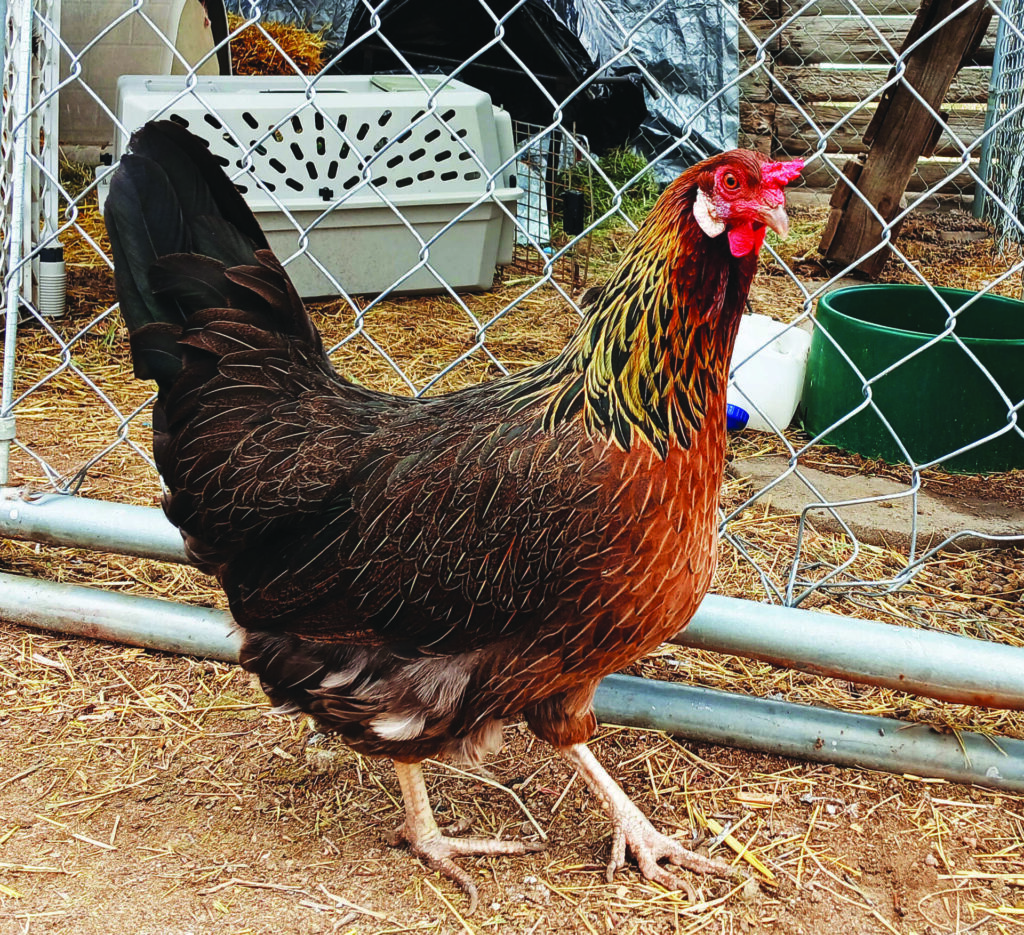
A good name for this hen who likes to wander would be Dora the Explorer.
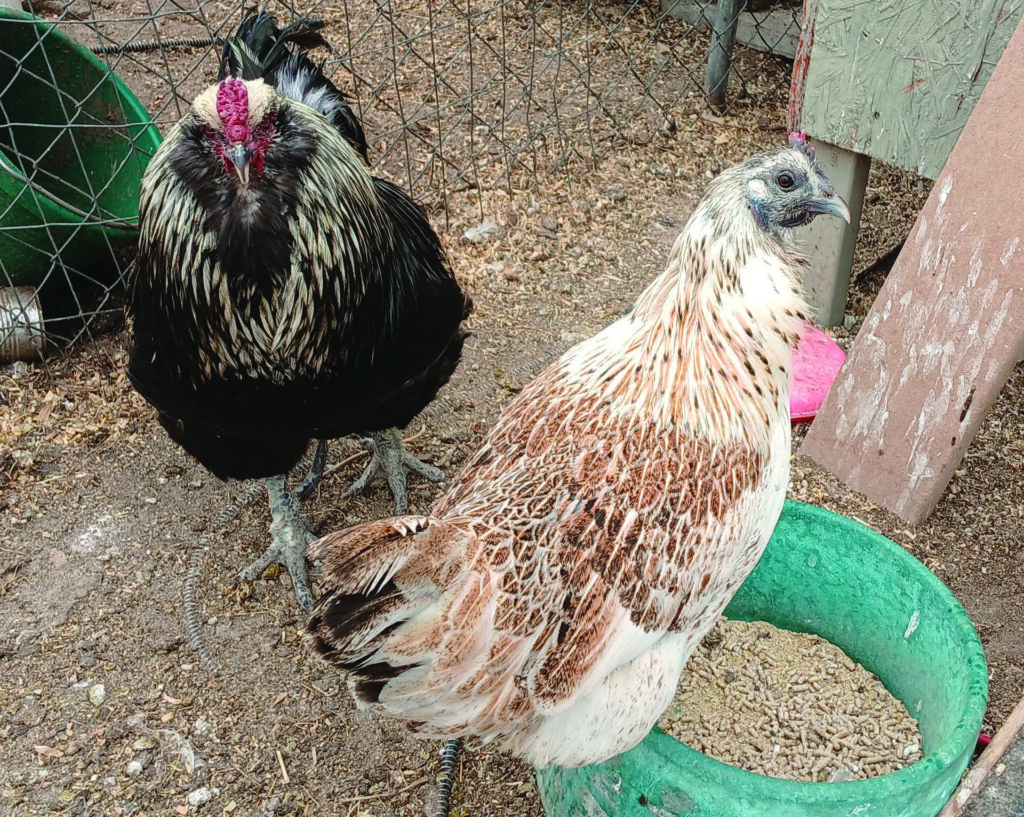
In back is Grandpa, the rooster and his roommate, Thumbelina.
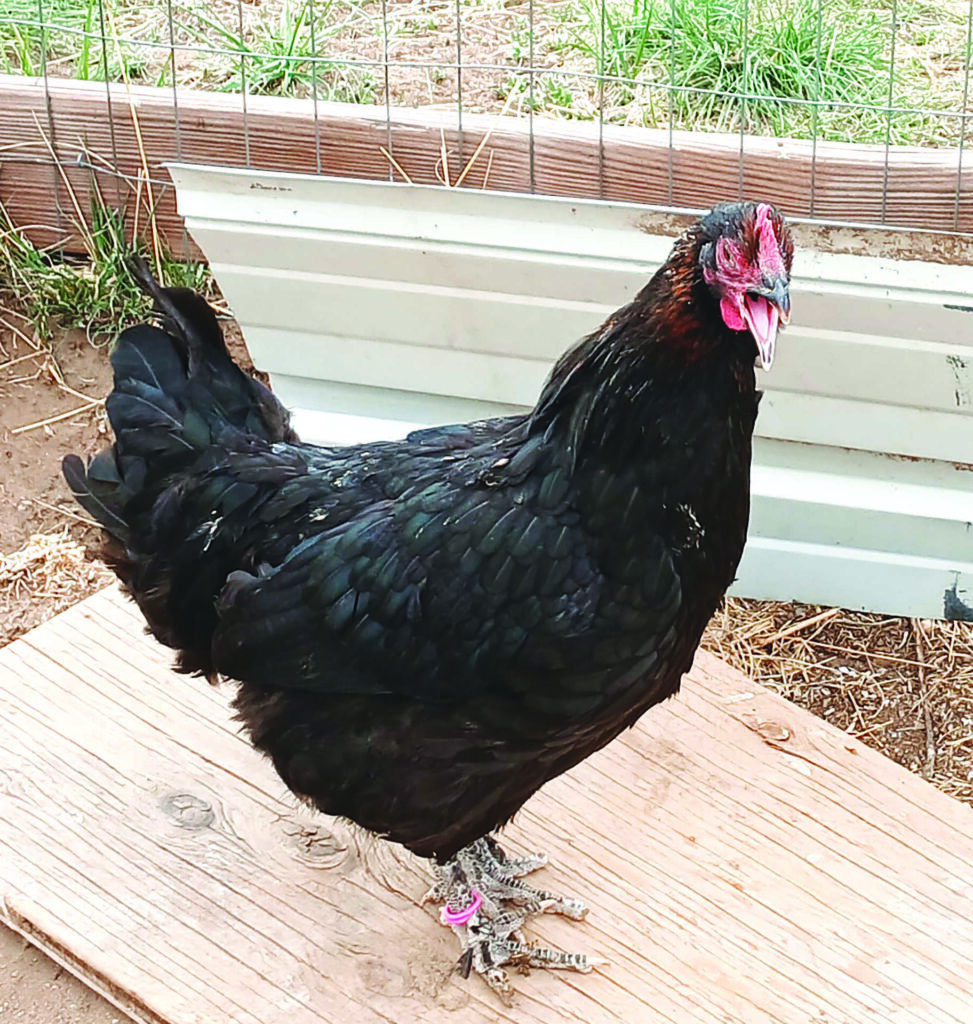
Betty, the hen who had to be nursed back to health, as identified by the pink band on her right leg.