The story of Corral Bluffs, Part 1
By Coben Scott
A natural wonder in Falcon’s backyard overlooks the quiet southern prairies: Corral Bluffs — the formation that has seen eternity.
Partially owned by the city of Colorado Springs, exclusive guided tours of the open space can be reserved until October. See information below.
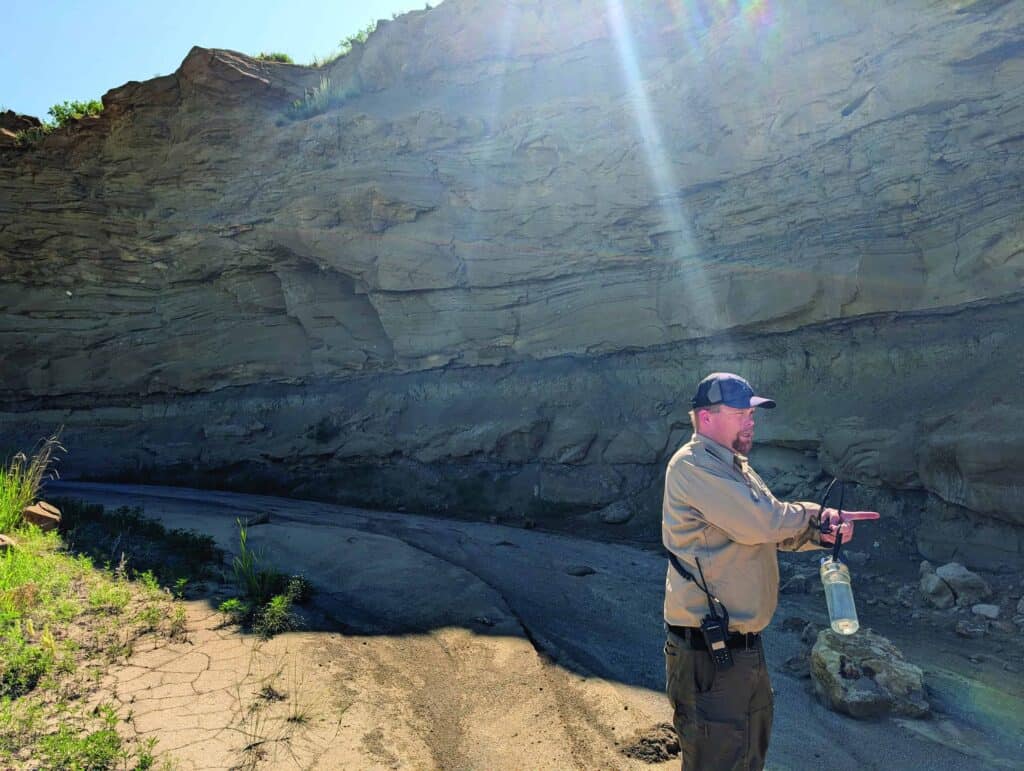
June 27 marked the unofficial “media tour,” including myself and The Gazette writer, Seth Boster. Leading us along the “Hike Through Time” was ranger Mike Bowman, the full-time peacekeeper of five years for the eventual open space. Bowman began the hike with the seven principles of Leave No Trace, then showcased several casts of creatures that once roamed in and around the bluffs. From a prehistoric crocodilian skull to a Triceratops horn, it set the mood for how important this bowl of cliffs is to paleontology.
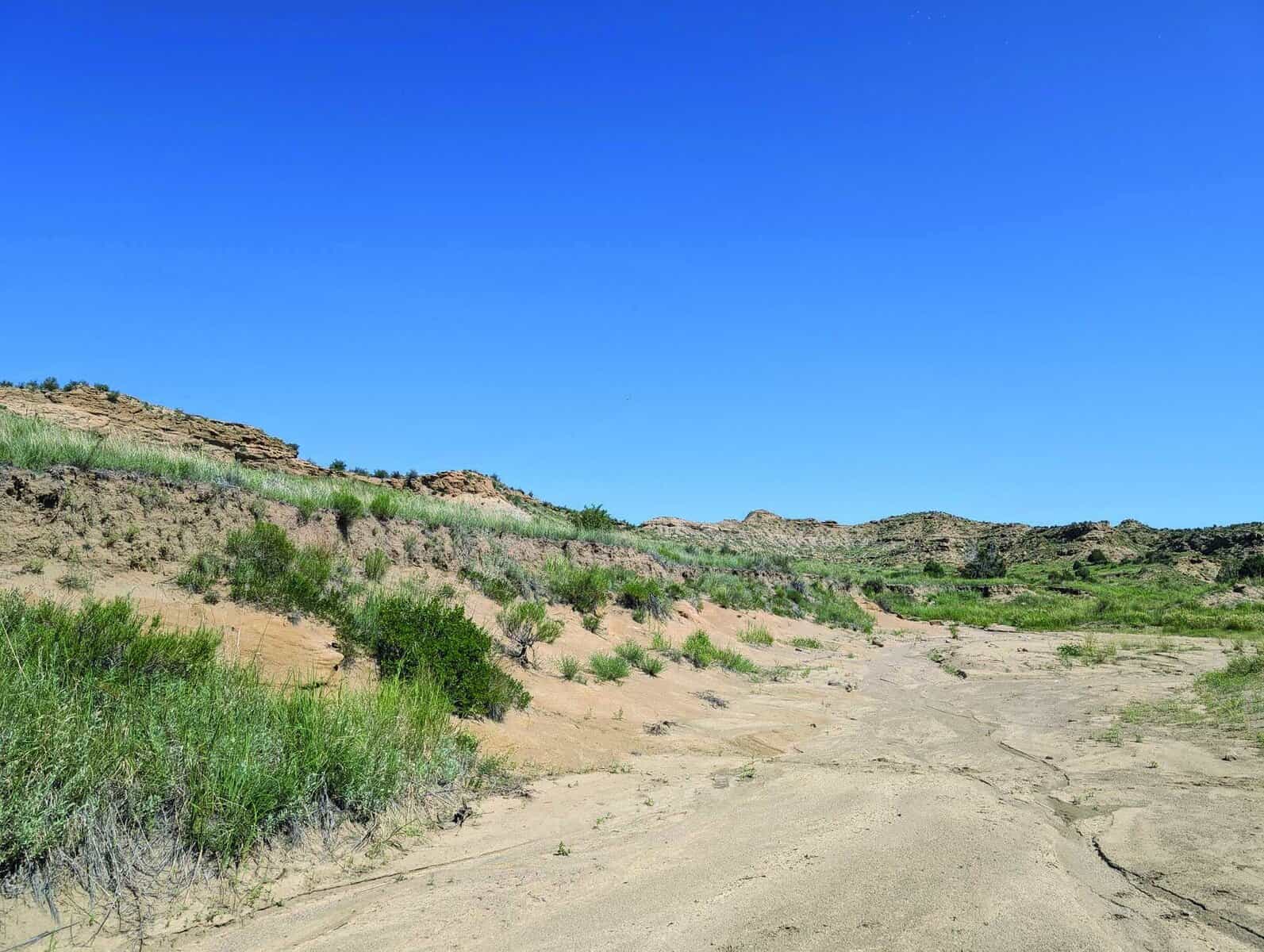
Geologically tied to the Dawson formation, the slot canyon-esque ravines that drop the bluffs have exposed countless stories of a time passed. Specifically shown in this tour, the story of the late Cretaceous and early Paleogene periods. While the land today has been classified as plains and prairies, Cretaceous Colorado was a much different scene. Rather than the rattlesnakes and cactus of today, back then it was more of a subtropical swampland, similar to the Florida Everglades, filled with ancient palm trees, amphibians, mammals and crops like beans.
The first point in the hike is marked by the KT Boundary, a distinct layer of dark sediment that lines the bluff walls. It is known as the marking line that signifies the extinction of the dinosaurs, the change in Earth’s rotation and the rise of mammals. Just above the line shows imprints that ancestral ferns left on stone, and the critters that scurried about had their stories saved with earth concreting around their skulls. Notably, Luxolophus can best be found here, an early mammal similar to the coati (a raccoon like animal) in appearance.
As the hike continued along the dry creek bed, the walls grew, and we moved further forward in time. Ranger Bowman explained that each stop is roughly 100,000 years ahead of the last one, with unique uncovering at each location. Regardless of the point on the tour, petrified wood could be seen lining the walls and scattering over the bank. Entire limbs were exposed. As the rains fall heavy and frequently in the high plains’ summers, more cliff sides of Corral Bluffs break apart, revealing more for the eager scientist. Coal is also abundant in the walls, understandably so as the carbon matter that did not fossilize or petrify would turn to the stocking stuffer we know today.
Roughly 400,000 years after the KT Boundary is “Bean World.” Here, the oldest legume fossil in the world was uncovered, changing the understanding of bean genetics and lineage as a whole. And 600,000 years marks the uncovering of mammal species like the Econodon and the recent discovery of Militocodon lydae. The latter was only found in 2024; the naming honors Sharon Milito, ex-science teacher, and Lyda Hill, a Colorado Springs philanthropist. Artillery shells are also likely to be found here, as for some time in the mid-century, the U.S. Army used the land for target practice. Among the forgotten prehistoric world, Bowman finds it particularly enjoyable to stumble across the old Army remnants. Another 100,000 years into the future and deeper into the ravine is where Taeniolabis can best be found. The creature appeared as a beaver-otter hybrid, roughly ankle sized. Concluding the walk in is roughly the 800,000 year mark and beyond. In more recent years, ancient and modern bison fossils have been uncovered, along with other Pleistocene creatures.
The leading paleontologist on these sites is Dr. Tyler Lyson of the Denver Museum of Nature and Science. Uncovering fossils from his youth, Lyson made discoveries early on. By the time he made it to Denver, he was browsing the archives to find a concretion of a late cretaceous mammal found at Corral Bluffs in the 1980s. Understanding how rare these are to find, Lyson and crew set out and did not leave the bluffs disappointed. While everywhere else in the world these fossils are nearly impossible to find, Lyson and company continuously found more and more. Those finds led to the museum purchasing land in the area and maintaining a research station in an old home at the bluffs. Paleontology is still incredibly active in this area, and surveillance is heavily monitored for the sake of preservation and safety of remaining fossils still to be found.
For the entirety of Bowman’s hike, the audience was in awe. Boster commented, “People are getting exposed to this walk with more perspective.” Bowman said, “To me, it’s just mind boggling how little we truly know.”
While the creatures uncovered from the bluffs are incredible, the ones that inhabit the region today are remarkable in their own right. The ancient pronghorn herds are roaming along the rims and valleys of the bluffs, golden eagles perch along the steepest of cliff sides and the Preble’s Meadow Jumping Mouse quickly hops the loamy sand to escape the jaws of a prairie rattler or yellow-bellied racer.
This year marks the first time the city of Colorado Springs is offering the service of bluffs tours, including the Corral Bluffs Association with guided hikes. Participants can expect world changing perspectives into paleontology’s past and the story of Falcon’s backyard. The history of this area of land alone is tightly packed with stories from every era of time. From Jimmy Camp, Corral Bluffs and the surrounding prairie, time has smiled on this stretch of the plains.
Part 2 of the story of Corral Bluffs will include the introduction of humans and the many notable faces to journey across the land.
To reserve a guided hike of Corral Bluffs, contact the Corral Bluffs Alliance at https://www.corralbluffs.org.