
By Jon Huang
Four years ago, Susan Yost had completed nearly 35 years working alongside her husband at the faith-based organization Cru, where they worked with youth and traveled across the country.
After settling in Colorado and living in Peyton since the early 2000s, the couple hoped to start a nonprofit offering art classes for teenagers, including music, dance and visual arts. When funding fell through, Yost began exploring other opportunities.
“Why don’t you do what you do best and try baking?” her son suggested.
Yost, now 63 and a mother of seven, began baking as a teenager. Her mother taught her to make yeasted bread, and her father showed her how to make cinnamon rolls.
When she launched her business, she started by making small cookies and fudge for a friend who had undergone bariatric surgery and needed smaller portions. She named the business Tiny Treats. Eventually, she shifted her focus to sourdough bread and renamed the business Crafted Crust. Yost said she prefers sourdough for its simple ingredients.
Making sourdough begins with a starter — a mixture of water and flour left at room temperature to capture naturally occurring yeast and bacteria from the air and flour. As the mixture ferments, its acidity increases, creating a live culture of microbes. The starter is fed additional flour until it matures, a process that takes about two weeks.
A small portion of the mature starter is then mixed into the dough, where it breaks down naturally occurring gluten and phytic acid — a compound found in seeds, nuts, grains and legumes that stores phosphorus. Fermentation improves digestibility and nutrition, reduces the bread’s impact on blood sugar and gives sourdough its airy texture and signature tang, Yost said.
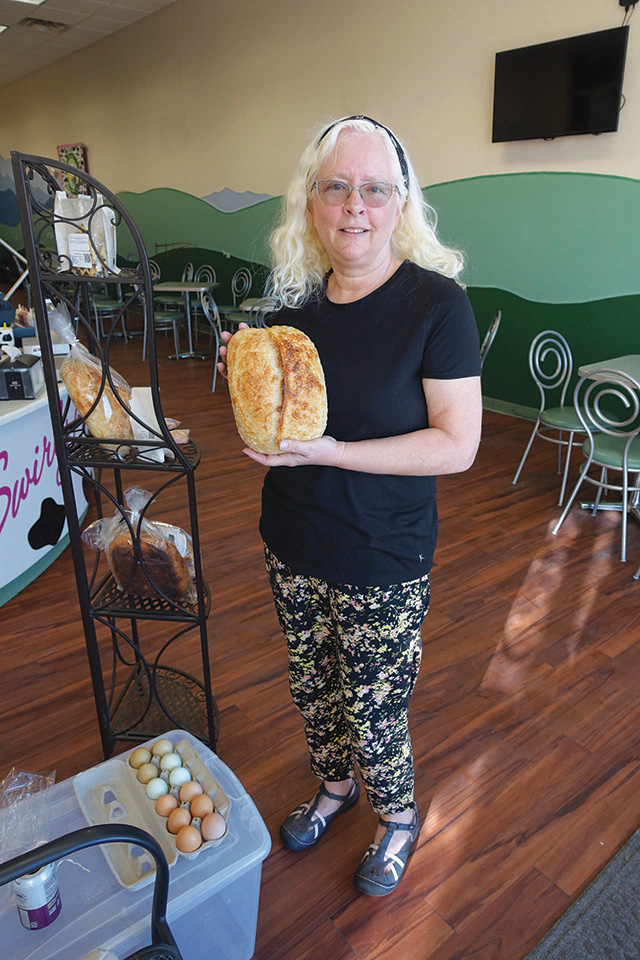
Susan Yost, owner of Crafted Crust, is planning to increase production of her sourdough bread from 15 to 10 loaves a week to nearly 100 loaves this spring.
Crafted Crust offers several staple loaves, including white sourdough (100% white flour), whole wheat sourdough (100% whole wheat flour) and a country loaf (20% whole wheat flour). For her whole wheat bread, Yost uses an electric mill to grind whole wheat berries into flour. She also makes bagels and pretzels, along with seasonal items such as lemon blueberry loaves, and offers custom orders.
Yost said her interest in nutrition is personal. Her parents struggled with chronic, diet-related diseases, and she is prediabetic. As a result, she has become more mindful of what she eats.
The white flour she uses is unbleached and unenriched. Whole wheat flour gives bread an earthier flavor and retains all parts of the grain, providing fiber, protein, fat and other nutrients that support gut health and other bodily functions.
Because of the health benefits of whole grains, Yost said she is incorporating more freshly milled whole grains into her bread.
Her baking process includes ancient grains such as einkorn, Rouge de Bordeaux, khorasan, spelt and rye. These grains, largely unchanged over time, are known for their drought tolerance, higher nutrient density and improved digestibility.
“It has a special flavor — the nuttiness,” she said. “My husband really likes that, too, because he prefers a more sour taste. Whole wheat and einkorn loaves tend to be more sour.”
Yost sources some of her grains from Grains from the Plains, a family farm in Hugo, Colorado, that specializes in locally grown whole grains and is part of the Colorado Grain Chain. Initiatives such as the University of Colorado Grain School, the Colorado Grain Chain and the Rye Resurgence Project promote education, awareness and growth of traditional grains while connecting local farmers with food producers, including distilleries, restaurants and bakers.
Another rewarding aspect of her work has been teaching sourdough classes, which she began two years ago. She has taught in homes and venues from Colorado Springs to Denver and has built a Facebook group with nearly 400 members. She also offers customized group classes.
“People post pictures and exchange ideas,” Yost said. “It’s been great.”
Her classes have also led to partnerships with Aspen Kitchens, a remodeling and design business in Colorado Springs, where participants receive a discount on store products, and with David Weekley Homes, where she teaches classes in model homes.
Yost said she also enjoys working with customers to create custom loaves. One older customer with multiple food intolerances requested a 100% rye loaf. When it came out dense, Yost offered it free of charge, but the customer insisted it was exactly what she wanted. Another customer shared ingredients from a favorite childhood bread, which inspired Yost’s Hearty Seeded Loaf, made with whole wheat, spelt and rye flours, along with sunflower, sesame and flax seeds.
Yost typically bakes 15 to 20 loaves per week but plans to increase production to nearly 100 this spring as she prepares to sell at the Monument Farmers Market beginning May 23. She currently offers Thursday pickups at the Swirly Cow frozen yogurt shop in Falcon.
Yost said sourdough has taken her in unexpected directions and has become a way to educate her community.
“I never dreamed I’d be starting a business,” she said. “It just kind of happened, and it’s been fun.”
For more information, visit:
[https://bakesy.shop/b/crafted-crust-sourdough-classes-bakery]Additional information on local grain initiatives:
[https://outreach.uccs.edu/grain] [https://www.coloradograinchain.com/] [https://www.grainsfromtheplains.com/] [https://ryeresurgence.com/the-project]