Down the permaculture rabbit hole
By Bill Radford
Jayme Domejka is on a mission: to spread the word about permaculture and bring new perspectives on how to tend the land and manage resources.
Domejka is the program director for the nonprofit Pikes Peak Permaculture, which provides permaculture education through courses, classes, workshops and training. She also owns Wild Oasis Permaculture, which provides permaculture consulting and design, project management and soil education.
“I didn’t really intend to build a business,” she said. “When I learned permaculture, I just thought it was very cool and intended to use it for me. Then I started figuring out that folks need to know this.”
So what is permaculture? Her website, wildoasispermaculture.com, offers this definition: “Permaculture is systems design science. It integrates land, resources, people and the environment through mutually beneficial synergies — imitating the no-waste, closed-loop systems seen in diverse natural systems.”
Put simply, she said, “It basically covers everything that you can possibly think of that people need to live — and live in abundance.”
Her fascination with permaculture began with a simple need: to heat her home.
Back in 2012, she said, there was a propane shortage across much of the West, and she couldn’t afford to heat her house. “So I started looking at ways to create heat that didn’t use a ton of fossil fuels. So thermal mass ovens and stoves, things like that, which led to heating structures with compost. Then that led to learning about biogas and using organic matter to make gas.”
And now she’s the one providing the education. For that, she was named El Paso County Conservation District’s 2024 Educator of the Year, hailed as “a catalyst, a visionary and a steward of the earth,” and then honored at the state level as the Colorado Association of Conservation Districts’ 2024 Educator of the Year.
In addition, she said, “I’ve always been a gardener, I’ve always been a horse person, I’ve always lived outside more than I lived inside. Eventually, the algorithm that Google put together from all of my searches started putting permaculture in front of me. I didn’t really see it for a while. Once I finally went, ‘What is this thing that keeps popping up?’ I looked into what it was and I was like, ‘That’s it. That is the thing that combines everything that I’ve been looking for probably my entire life, and I didn’t know that it existed.’”
From there, she said, “I went down the permaculture rabbit hole hard,” beginning with every free resource she could find. Through online permaculture design classes, in-person courses and continuing education, she earned multiple certifications.
Domejka lives on about 5 acres in the Falcon area with a variety of animals, and her typical client is a homesteader like herself.
“We move onto a property and we’re like, ‘We’re going to get goats, we’re going to get chickens, ducks, horses, we’re going to get all of these creatures,’” she said. “And then we have to take care of all of these animals. And the thing that is missing is the system where everybody overlaps and things can roll into each other.”
As a result, chickens may provide eggs, but they can be put to work in other ways, too. Domejka can throw weeds from her garden over the fence to her chickens.
“They can pick through it and choose what they want,” she said.
What’s left can be tossed into the compost pile. Later, the chickens can be allowed access to the compost pile to scratch through it, reducing the need to turn the compost manually. While she wouldn’t give chickens full-time access to her garden because of the destruction they could cause, she might let them in near the end of the day to gorge on grasshoppers because “their instinct says catch insects first.”
And what’s in her garden?
She said it’s all about providing calories, so there are potatoes, tomatoes, peppers, eggplant, beans, peas, carrots, beets, turnips, radishes, lettuce and more. Some crops, such as broccoli and cauliflower, don’t do well in the spring, she noted, so they’ll come later.
“For most people, coming into my garden, it looks like chaos. And it’s not. Polyculture farming (growing multiple crops in the same plot) is something that has been found to be incredibly effective and also very soil-building.”
And speaking of soil building: “One of the things that comes up that I hear the most when I’m teaching is that the soil in Colorado is horrible, and that is not actually the reality,” Domejka said. “We used to be sea floor, so we have a lot of amazing mineral content in our soil. What we are lacking is organic matter and moisture.”
Adding organic matter, along with mulch to help retain moisture, is key, she said.
Still, she acknowledged gardening here can be tough, with everything from late frosts to July hailstorms to ravenous grasshoppers.
“I actually tell people that gardening in our region is an extreme sport,” she said. “It’s pretty challenging, but it’s not impossible. I am proof of that.”
Pull quote: Wildoasispermaculture.com, offers this definition of permaculture: “Permaculture is systems design science. It integrates land, resources, people and the environment through mutually beneficial synergies — imitating the no-waste, closed-loop systems seen in diverse natural systems.”
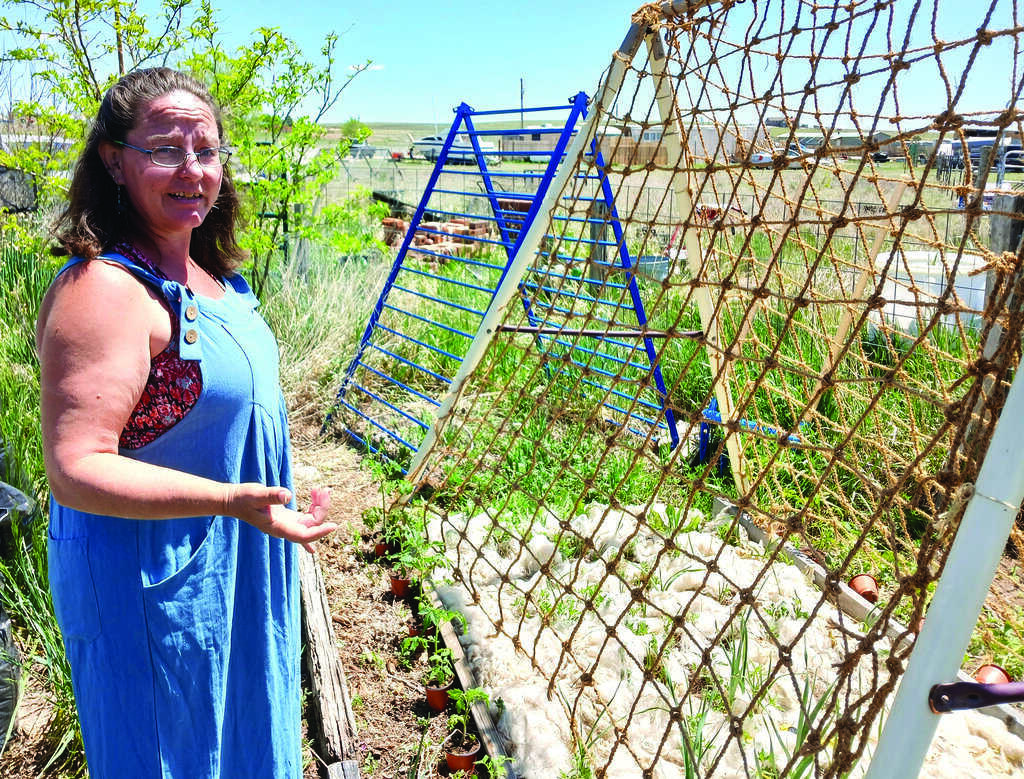
Jayme Domejka’s garden is set up to provide good calories: potatoes, tomatoes, peppers, eggplant, beans, peas, carrots, beets, turnips, radishes, lettuce and more.
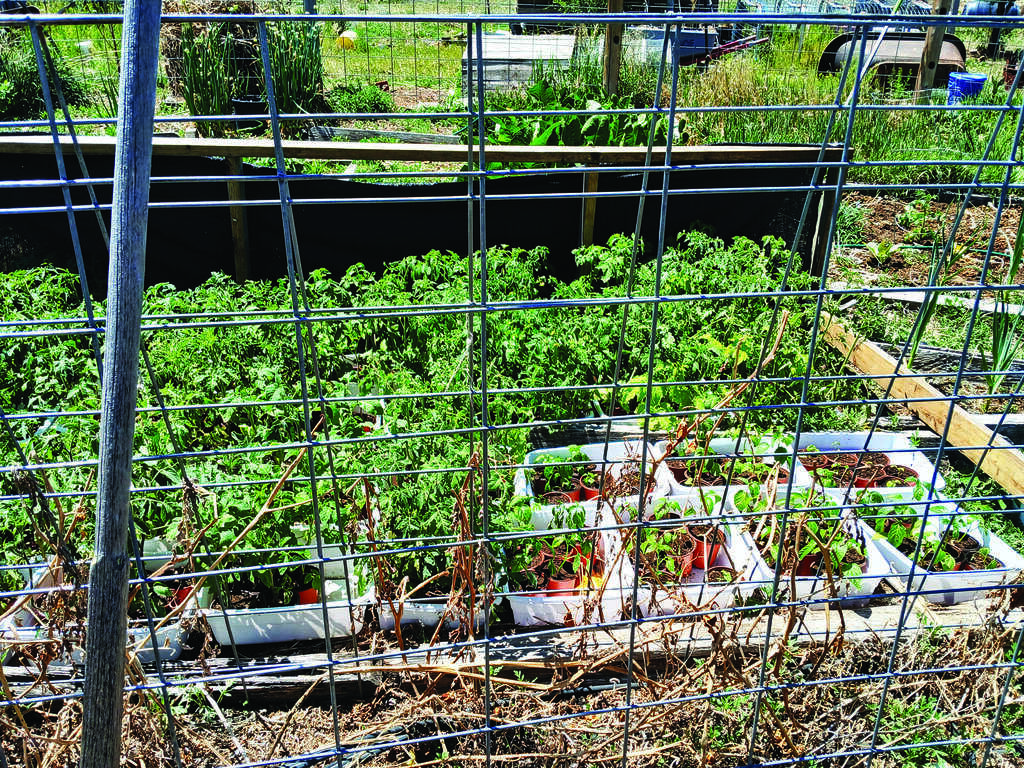
Jayme Domejka is the program director for the nonprofit Pikes Peak Permaculture, which provides permaculture education through courses, classes, workshops and training. She also owns Wild Oasis Permaculture.
\