Coben Scott is a history graduate, a history buff, and he has explored and researched much of Falcon and the area’s past. Coben’s column, Yesteryear, features stories about the history of the plains.
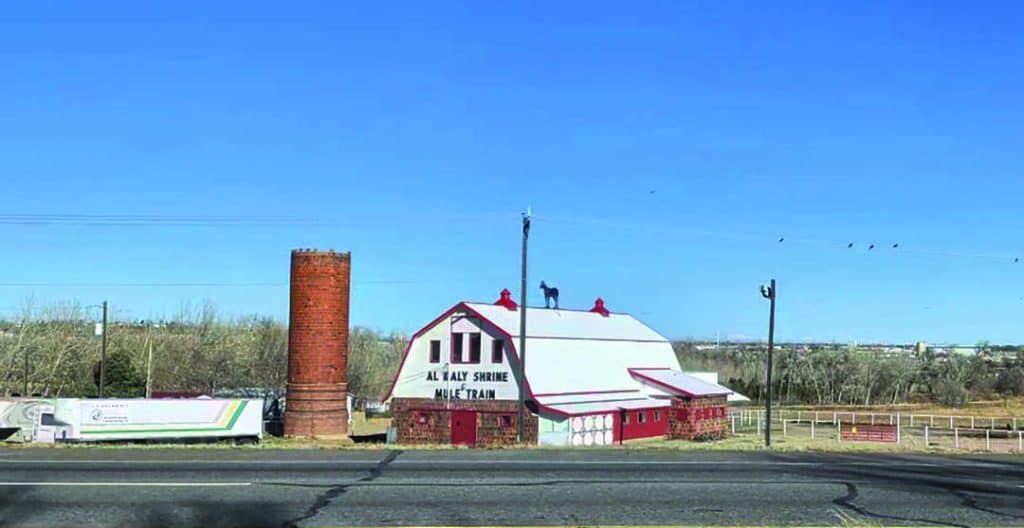
The Banning ranch headquarters were housed where the Al Kaly Shrine Mule Train barn is located today. The barn can be seen from the south end of Interstate 25.
The history of Banning Lewis, Part 1
By Coben Scott
Ranching has long been woven into the history of the Pikes Peak region, but among the many cattlemen who came and went, the Banning-Lewis name stands out for a legacy that reaches far beyond cow punching.
Before the names were ever joined, there was William Banning. His early life looked much different from the one he later built in Colorado. Known as a soft-spoken man who rarely discussed his past, Banning left many details to speculation. What is known is that he was born in Kentucky in 1855 and eventually joined the Custer Scouts — the personal scouting unit of George Armstrong Custer. Custer is best remembered for his defeat at Little Bighorn, a legacy that has overshadowed his earlier reputation among many in the West. Colorado’s Custer County was named in his honor despite no record of the general ever visiting the state. Banning was one of the last surviving members of the Custer Scouts.
At some point, Banning moved from the Dakota Black Hills to the Pikes Peak foothills, settling in Colorado Springs in 1885. There, he launched his first business venture: the Union Ice & Coal Co. He capitalized on the growing need for both heating and cooling by transporting and supplying ice, coal and later fuel. A few years later, he purchased 400 acres on the southern edge of Colorado Springs, where he raised both cattle and horses. Although cattle proved profitable, Banning’s passion was Percheron draft horses — a large, powerful breed capable of hauling heavy wagons loaded with ice and coal. The ranch headquarters sat where the Al Kaly Shrine Mule Train barn stands today, greeting travelers as they enter Colorado Springs from the south on Interstate 25.
While building his business and ranching reputation, Banning also raised two children, William Jr. and Ruth, and served on the town’s police committee.
Tragedy struck the family in 1914 when Banning died of a heart attack in his office. Two years later, William Jr. died of heart complications shortly before he planned to join the military. Banning’s death left his widow, Elizabeth, and daughter, Ruth, to manage the family’s affairs.
Ruth was in her final year of college when her father died; she was working as an English teacher when her brother passed away. After inheriting the family’s assets, she decided to reshape her life. She continued operating the Union Ice & Coal Co. for a time, but her growing interest was in cattle and stock. In 1917, she purchased her first parcels of land between Colorado Springs and Falcon.
Around this time, Raymond “Pinky” Lewis entered the story. Born in Missouri in 1892, Lewis moved to Colorado Springs with his family as a child. He grew up deeply involved in local sports and later enrolled at Colorado College, where he became a standout football player. Lewis earned the nickname “Pinky” because his face flushed bright pink during games — a name that stuck with him throughout his life. Old-timers who knew him still refer to him that way.
At some point, Ruth Banning and Raymond Lewis met and began courting. The couple married in a small ceremony with only close friends and relatives in 1921. A year later, they traveled to Denver for the National Western Stock Show and purchased 10 heifers to graze on Ruth’s eastern acreage. That simple purchase marked the beginning of what would grow into the Banning-Lewis Ranch.