
By Jon Huang
For the Kitts, their life has always been connected to nature.
Steve Kitts grew up on a farm in Athens, Ohio. His grandparents grew grains, raised cattle, and his parents had a 200 cow-calf operation where they produced grains and 6,000 bales of hay a year. In their family of six, the Kitts grew vegetables, fruit trees, raspberry bushes and grape orchards. Eating their own food year-round, they also canned their own produce.
Kitts bonded with nature early on as a former horse trainer and skier. Growing up, he struggled with the calf-slaughtering process.
“I always had a rough time with it,” he said. “You feed a beautiful little creature and then you got to kill it. It didn’t bother my father and I had no option in it. I did not like it.”
His family also had a place in the Eastern Pennsylvania suburbs where Kitts spent time growing up; he eventually met his wife, Debbie, who grew up in the Philadelphia suburbs and the two often visited Steve’s parents’ farm. She said she loved being around the animals and the farming culture.
“I think it was meant to be,” she said.
After moving to Colorado, the Kitts found less moisture, greater temperature swings, hail and different soil. It was a more challenging climate to grow produce outdoors compared to the Midwest. Steve had various jobs, including working as a solar engineer, a horse trainer and then eventually moved into film production making instructional videos on how to train horses. Eventually, the two moved to Breckenridge, where Steve had his own video production company and Debbie worked as an administrative assistant and fire inspector for the local fire department. The two regularly met up midday to ski, skiing up to 100 days a year. Ten years ago, they moved to the Peyton area. This past year, they started Colorado Fresh Greens with a vision to grow nutritious microgreens and herbs.
“There’s a need for sustainable farming instead of trucking everything in,” Steve Kitts said. “We saw that we could contribute to that by growing with a sustainable system, using organic practices.”
When a seed first sprouts, it grows its first set of leaves called cotyledons. From there, it grows an additional set of leaves called “true leaves,” Kitts said. It is at this point a seed becomes a microgreen, which, depending on the plant, is harvested anywhere from one to three weeks into the process. Microgreens have been promoted as nutrient dense alternatives to growing traditional produce and is often used for their decorative quality and concentrated flavor.
Kitts said growing microgreens indoors requires conditions that mimic nature in exchange for a more controlled environment. Seeds can be grown in soil-based and soilless mediums. The Kitts grow their seeds hydroponically indoors in a 600-square-foot building on their 35-acre property. The seeds are placed in a coco coir soil medium derived from the outer husk of coconuts and helps maintain the moist environment necessary for seeds to germinate.
Once the seeds are spread onto these trays, they are placed on racks, Kitts said. Each rack sits underneath grow lights that are meant to mimic sunlight and provide the necessary light frequencies for the seeds to grow. Water is pumped up through tubing from two 40-gallon tanks, one containing extra nutrients for the specific plant species that need them. The watering system is controlled by timers to generate 3-minute watering cycles that deposit one-fourth inch of water in the trays that then drains back down to the tanks. On the side of the racks, small fans blow “wind” to help control the moisture and conditions that allow the sprouting microgreens to develop sturdier stems.
Most seeds need only water while others benefit from added nutrients such as kelp extract.
Kitts began learning many of the growing practices through videos online, consulting with other growers, and from his own growing environment.
“You can learn about these things but you have to learn the nuances,” he said. “There are a lot of ways to do things and we haven’t had success with everything that everybody has said.”
Seeds can take about a week to germinate. It can take another two to three weeks before harvesting. Cilantro microgreens, for example, can take up to nearly four weeks to grow.
Seeds can take about a week to germinate. It can take another two to three weeks before harvesting. Cilantro microgreens, for example, can take up to nearly four weeks to grow. When it comes to harvesting, Kitts said it can be a time-consuming process cutting them by hand.
“It’s soothing though, it’s almost meditative,” he said regarding the process.
To maintain a clean growing environment, the water tanks are changed out every two weeks, the coco coir is composted and fed back to the soil on their 35-acre property. The packaging used for the greens is also compostable and made from a corn resin material, Kitts said. The goal is to promote a cyclical environment where everything in the growing process is reused and reincorporated.
Because of the more controlled growing environment, microgreens can be grown year-round. At age 71 and 69 respectively, growing indoors in a 600-square-foot-building has given the Buchanans a manageable space to return to their farming roots to provide “harvest to table freshness” through the food they grow, Kitts said.
Currently, the Kitts are growing radish, cilantro, arugula, broccoli, “Bull’s blood” (an heirloom beet variety) and field peas. They sell direct to consumers via a weekly subscription model as well as a wholesale distribution to local restaurants such as Carlos’s Bistro and the Warehouse, Kitts said. Chefs desire them for their aesthetic appeal; individual customers often seek certain greens for their higher nutrient density.
As they continue to grow the business, their offerings may change depending on what their customers demand, but regardless, they plan to do it with the same connection and thoughtfulness they have cultivated towards nature, their surroundings, and their community.
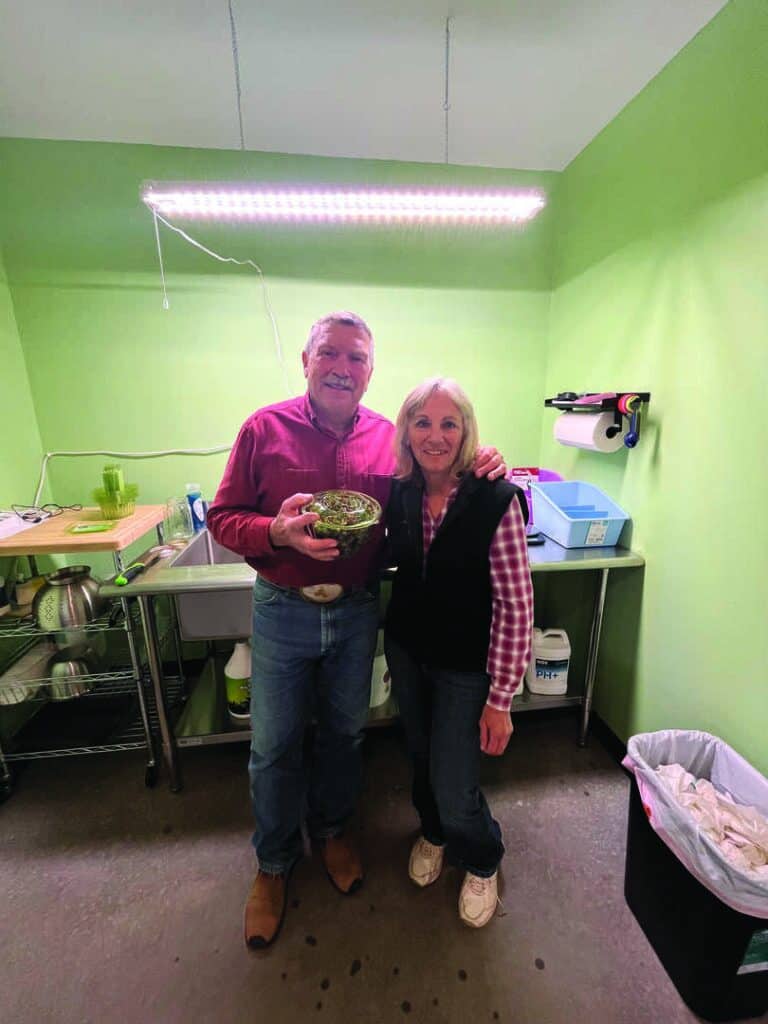
Steve and Debbie Kitts grow fresh microgreens for the Colorado Springs and surrounding community.
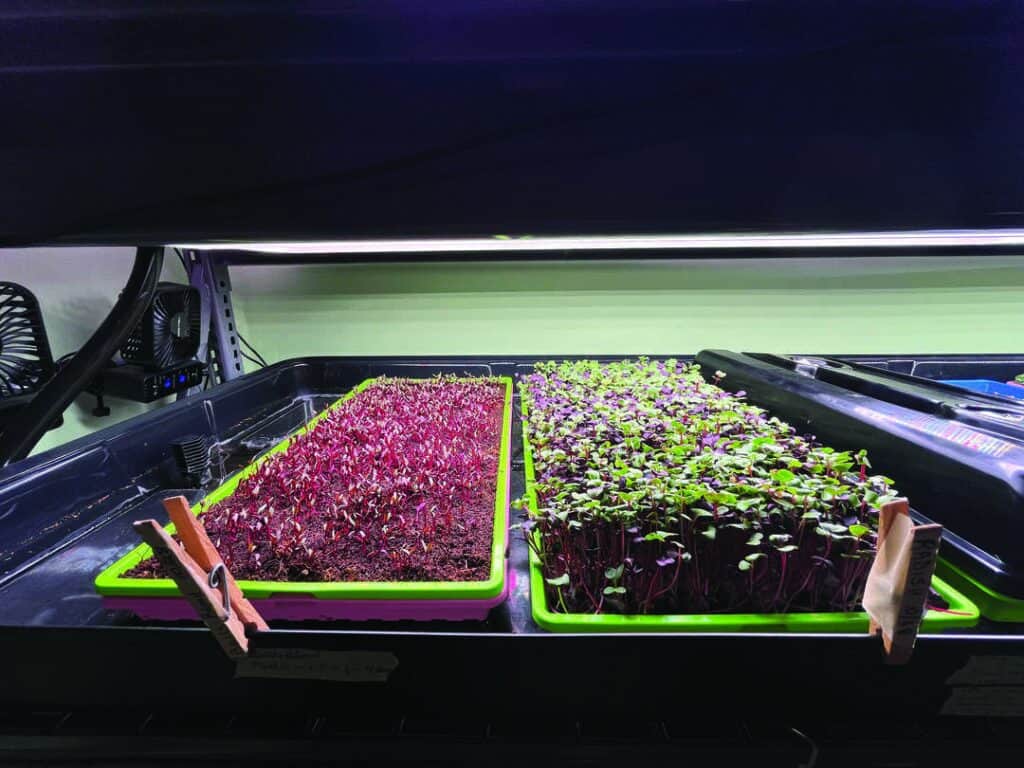
Bulls blood and radish microgreens are grown in coco coir (soil) medium with trays that are watered underneath grow lights.