By Jon Huang
In the 1990s, Jon Wuerth and Carol Stansfield were elementary science school teachers at High Plains Elementary School in Colorado Springs. Back then, the curriculum was compartmentalized into separate subjects like reading, writing, social studies and science. The two were often bothered by how science was isolated to experiential learning and separated from other subjects.
“I always realized that wasn’t really the best way to teach people going from one subject to the next,” Wuerth said. “There’s some advantages to that, but it was better to integrate science with reading and writing as well.”
They envisioned a more holistic way of teaching science.
The two shared a tiny office at the school the size of a closet. One day, they discussed how Stansfield had found out the district had been given a lease on 640 acres of undeveloped property in Black Forest for educational purposes; Wuerth had just been approached about designing a new science curriculum. Within 40 minutes, the two drafted a blueprint for what became “School in the Woods.”
In 1999, the two hosted the first class of 52 students and the school was held in two portable buildings, transported from a local high school onto the forested property.
“Carol and I were extremely busy in terms of what we had to do, everything from the teachers to the lunchroom people,” Wuerth said. “We did all the specials, whether it was physical education, arts … but we were so thrilled and felt so fortunate to be able to start a school in a way that we thought a school should be created and the way we should teach curriculum and the way we should build a community and develop responsibility with our students.”
Today, School in the Woods hosts 78 fourth graders in a fully immersive interdisciplinary science-based curriculum. A new permanent building was constructed in 2019.
Patrick Perry, a former teacher at SITW and the current administrator, vouches for the school’s approach. “When in doubt, take them out, go outside.”
Students are assigned one of 27 different roles that include beekeeper, meteorologist, composter, dishwasher, photographer and a person who vacuums. One student must write and perform a haiku (a Japanese poem) about something they learned during the week. The idea is to instill a sense of ownership in the school, which includes allowing the students to choose a new yearly school mascot.
Students are assigned one of 27 different roles that include beekeeper, meteorologist, composter, dishwasher, photographer and a person who vacuums. One student must write and perform a haiku (a Japanese poem) about something they learned during the week. The idea is to instill a sense of ownership in the school, which includes allowing the students to choose a new yearly school mascot.
“We want the kids to be in an interactive environment,” Perry said.
Inside, an enclosed beehive gives students a close-up look at a colony. The library’s custom-made tables are embedded with various animal bones, rocks and vegetation, encouraging students to interact with the natural world.
The school has a rich history of community support. In the early years of SITW, a student’s grandfather donated $10,000 for computers. Every year, a former teacher’s mother hand knits warm hats for all the students. Each week, volunteers teach children how to make homemade snacks like black bean brownies and freshly made garden salsa.
Outside, the kids eat lunch on benches and have recess in a wooded area called “Wicki town,” a reference to a wickiup, which is a temporary housing structure built out of tree saplings and branches by local indigenous peoples, including the Ute. The students construct their own wickiup and are encouraged to create collaborative activities. One group constructed a storefront to sell feathers, rocks and other various collected artifacts. Another has carved a bowling alley of sorts dug out of the ground. In another part, a few grind pigmented rocks to create their own paint powder.
Perry recalled one year where students spontaneously created their own live news agency that included a set, tree-branch boom sticks and ear pieces.
“They were like ‘all right, over to camera two,’ and it was awesome,” he said.
The current building manager is also an avid gardener, using the onsite raised beds and greenhouse to show students how vegetables like tomatoes, peas, squash and peppers are grown. The property also includes an archery range and amphitheater; and, in the winter the kids go sledding and snowshoeing.
The books the children read include nature topics, providing an opportunity to read and write on subjects they see firsthand. For example, when they read the “Firebug Connection,” a science mystery about dying insects, each student was given a mealworm to care for until it matured into a darkling beetle.
“When they’re at a school like this, they get enough natural curiosity, but then with that, scaffolded with it, is direct instruction about the items that they’re seeing and learning about,” Perry said.
Molly Estabrook is one of SITW’s current teachers. She grew up in Vermont, studied environmental science and wildlife biology and had prior experience with outdoor camps and in science-related fields. In her opinion, while teaching to the same state standards, she feels her students regularly exceed that in their educational experience at the school.
“Outdoor learning is all really great. I love seeing the kids get to explore,” Estabrook said.
There are challenges.
“Bringing 27 kids outside as one teacher, I think that’s really important to be able to set some boundaries,” Estabrook said. “We really emphasize … that the students have this self of learning, but we need to be able to create a trustworthy environment outside.”
The weather is an obvious factor. Perry said last year the school had class outdoors for all but 13 days.
For Wuerth, the physical interaction with the natural world is as important as ever in today’s technologically driven world. He said there is often a frenetic pace and volume at which kids receive information. There are demands on educators to control classrooms with overly regimented curriculums.
“I think the more we try to control, it’s like putting a lid on the boiling pot and we’re trying to hold it down and it’s boiling, and you’re trying to hold it down and it doesn’t seem to work,” Wuerth said. “What SITW has is the sense of community, and honoring individual differences that our children have, everything from the need to be able to move, to get up … to the freedoms that they were allowed to have to explore the natural world for recess and use their sense of imagination.”
Each student who enters SITW is given the title of naturalist. Upon completion of the year, each creates a tile with their unique imprint as a reminder of their enduring connection to the school and the natural world.
After nine years at the school, Perry feels as strongly as ever about the school’s mission.
“I can’t think of any age group that wouldn’t benefit from having some sort of outdoor learning,” he said.
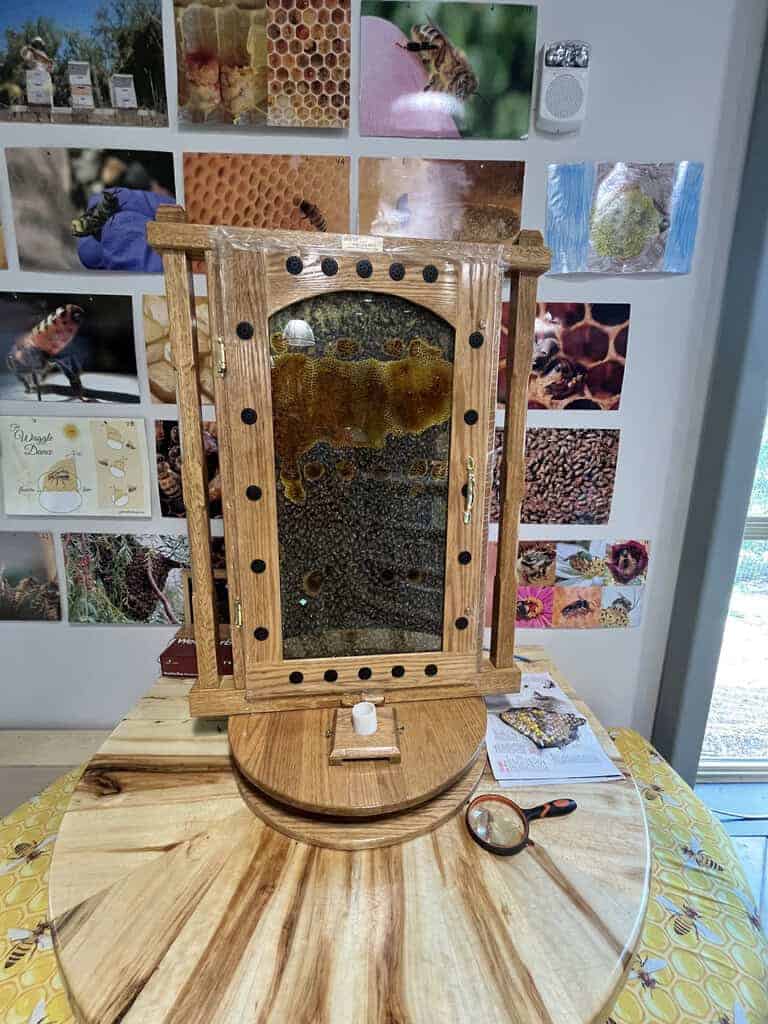
An enclosed beehive gives students a close-up look at a colony. This beehive also has access to the outside.
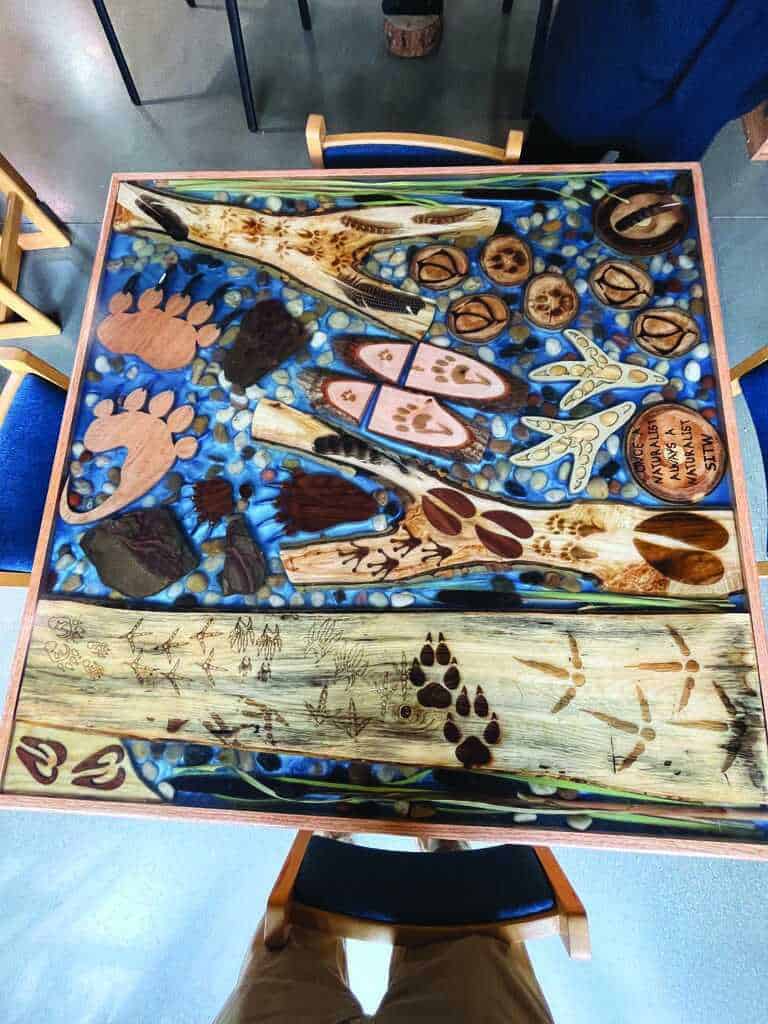
The library’s custom-made tables are embedded with various animal bones, rocks and vegetation.
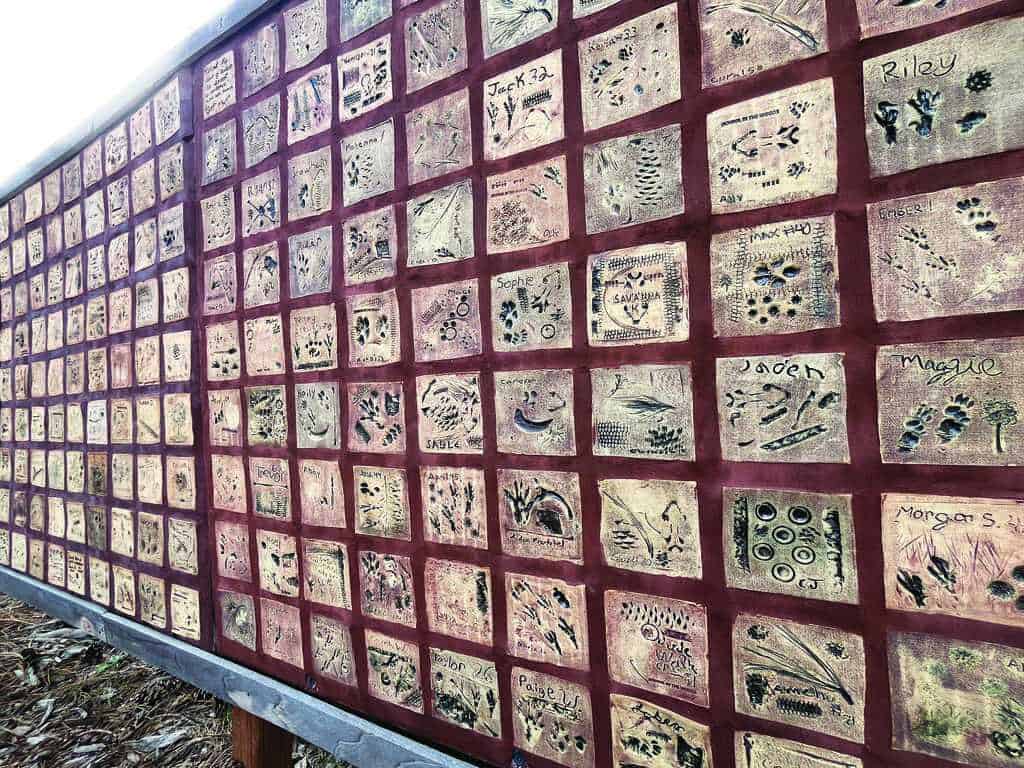
These tiles, created by graduates, are mounted along an outdoor wall to commemorate alumni.
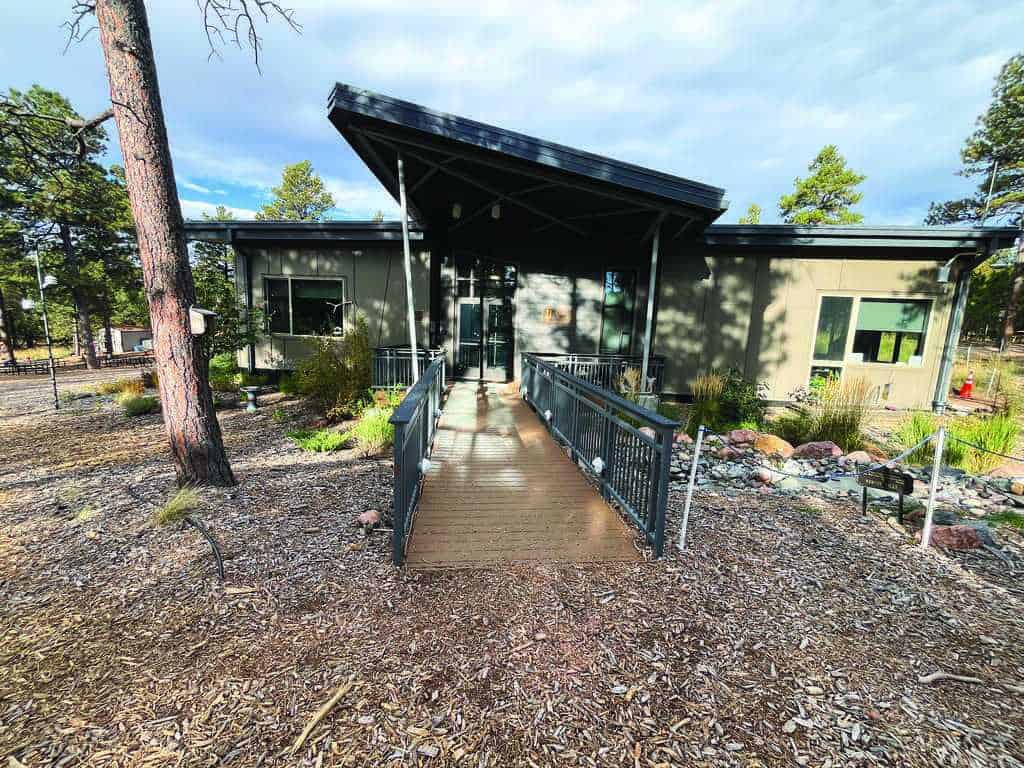
This is the front entrance of School in the Woods