Longtime local journalist Bill Radford and his wife, Margaret, live on 5 acres in the Falcon area with chickens, rabbits, dogs, cats, a flock of parakeets, goats, two horses and two ducks. Contact Bill at billradford3@gmail.com.
Mounds of mystery
By Bill Radford
It was late September, as summer was grudgingly giving way to fall, that I first saw the mounds.
There were a dozen or so along the southern edge of our pasture and my first thought was: prairie dogs.
If so, they were not welcome; for one thing, holes left by prairie dogs can pose a danger to horses – or people – who stumble into them. But my wife, Margaret, who has dealt with prairie dog colonies a bit in her work life, assured me the mounds were not left by prairie dogs. If so, the mounds would be a lot bigger. Plus, more significantly, nearly all the mounds did not have a hole at top, and thus no opening for a prairie dog to pop out of.
So what was responsible? In researching, moles or gophers seemed the most likely culprits. Our neighbor to the south, whose pasture also had similar-looking mounds, blames moles, as does Margaret. But my money is on gophers.
If it’s moles, they are apparently eastern moles. “There is just one species of mole in Colorado, and it is restricted to the eastern plains, where it lives in sand hills, on sandy flood plains, fields, lawns, cemeteries and golf courses,” Colorado Parks and Wildlife says on its website
If it’s a gopher to blame, it’s likely the plains pocket gopher. States Colorado Parks and Wildlife: “Every part of Colorado has some kind of pocket gopher. … The northern pocket gopher lives in the mountains and northwest, the valley pocket gopher inhabits southern and western valleys, the chestnut-faced pocket gopher is found in the southeast, and the plains pocket gopher, logically enough, lives on the plains.”
So what’s the difference between the two species? Well, they both like to hang out underground, obviously. Gophers are rodents; moles are not. Moles are insectivores (insect eaters) while gophers are herbivores; the diet of a pocket gopher, CPW says, “consists of primarily roots, tubers and succulent stems under meadows, pastures and hay-lands.” While their presence is not welcome in gardens or in nicely manicured lawns, the digging by both animals can actually be beneficial. “Moles help build soils, mixing rich material from near the surface with mineral soil from deeper tunnels,” CPW states, while pocket gophers “aerate the soil … and provide deep channels that conserve runoff.”
All that digging creates distinctively different mounds of dirt, various sources say. And that’s where it gets confusing for me. Mole mounds are round, conical formations said to resemble miniature volcanos and typically smaller than those created by gophers, which are described as fan- or crescent-shaped. A fact sheet online from Colorado State University Extension notes that mound-building activity by gophers is usually greatest in spring and fall, and they also offered this astounding fact: “One gopher brings about 2 1/4 tons of soil to the surface each year.”
To me, the mounds in our pasture most closely resemble the images of gopher mounds online; Margaret, on the other hand, thinks they are mole hills. I confess I haven’t seen one tell-tell sign of a gopher mound: eskers that result from burrow building and are described by CSU Extension as “long snake-like mounds of soil looking like above-ground soil-filled tubes.”
So, I posted photos online on Nextdoor – and, of course, got divided opinions there.
“I think it’s a pocked gopher by the looks of it,” one neighbor posted in response. “They are very active in the fall (& spring) building food tunnels.”
On the other hand, another neighbor posted her own photos and wrote, “Yes, they are moles & they are pissing me off.”
Still in search of an answer, I reached out to an expert — Allisa Surbuchen, horticulture specialist for Colorado State University Extension in El Paso County.
Zurbuchen’s verdict, as expressed in an email: “This type of mound is very consistent with pocket gophers due to its size, fan shape, and the lack of a distinct hole in many of the mounds.” A fact sheet Zurbuchen sent me stated, “Moles occur only in specific areas on the eastern plains of Colorado. Damage blamed on moles is most likely done by another species.”
So what am I going to do about it? At this point, just monitor. The mounds aren’t near the garden and aren’t endangering anyone. As far as options if I felt I needed to take action, Home Depot offers a variety of steps to get rid of moles and gophers. Among humane measures it lists on its website: eliminating their food source, spraying with liquid repellents, scattering repellent granules, using barriers and/or digging trenches lined with wire mesh or hardware cloth. There are also sonic devices to scare them off and catch-and-release traps. The last resort are poisons or chemicals. Home Depot says one of the most effective home remedies is castor oil, which acts as a repellent. However, it says, “Skip the moth balls, tea tree oil and cayenne pepper for pest control; they are not effective.”
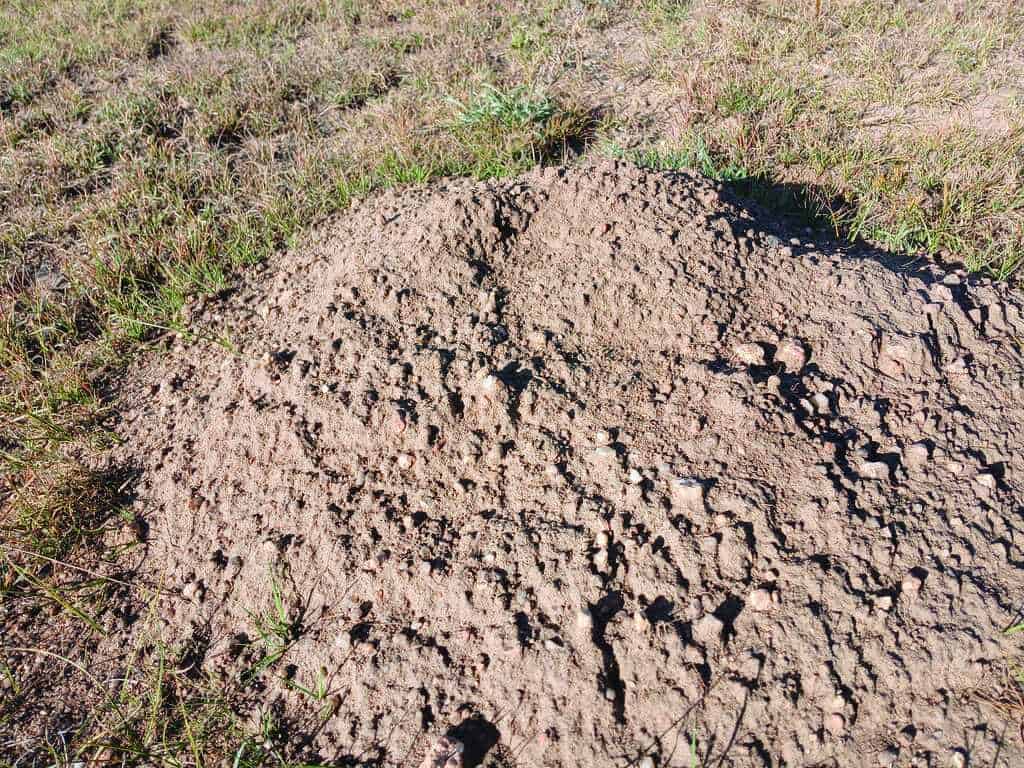
One of the mystery mounds found on the Radford property this summer. Photo by Bill Radford
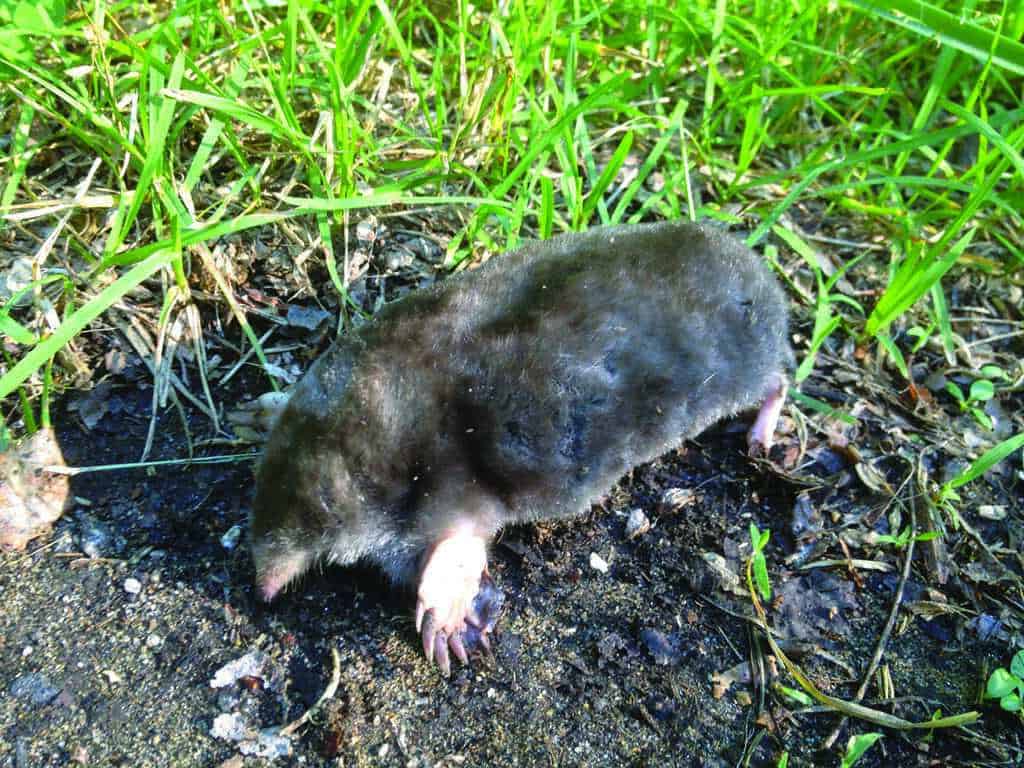
This is the relaxed eastern mole, which is the only mole species in Colorado; it lives on the eastern plains in “sand hills, on sandy flood plains, fields, lawn, cemeteries and golf courses,” according to the CPW. Photo by Gary Stolz, U.S. Fish & Wildlife Service