Coben Scott is a history graduate, a history buff, and he has explored and researched much of Falcon and the area’s past. Coben’s column, Yesteryear, features stories about the history of the plains.
The Story of Corral Bluffs, Part 2
Coben Scott
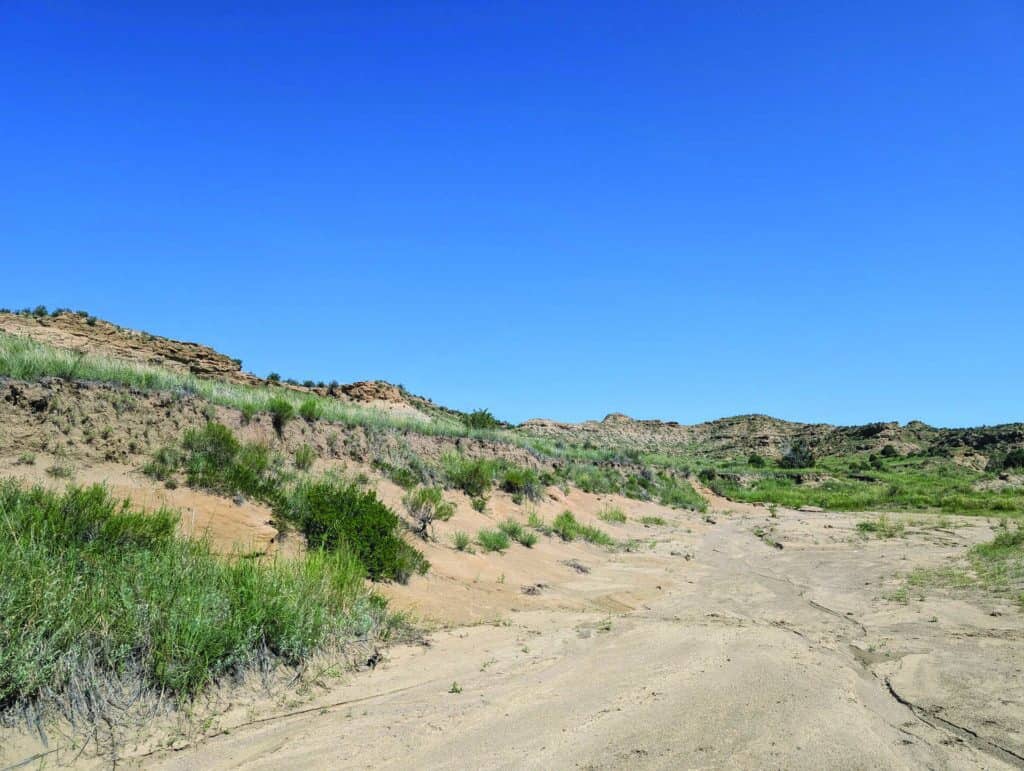
Long after the end of the dinosaurs, rise of the mammals and growth of the Rockies, humans unknowingly found the petrified primordial swamp that is Corral Bluffs.
The original discoveries are unknown today, although evidence of the paleo people crossing the plains shows humans have utilized the bluffs for a long time. Tools and pottery from Corral Bluffs and the neighboring Jimmy Camp date back thousands of years, creating an archeological hub on top of the groundbreaking paleontological discoveries. Further down the line, it is well-documented that the Ute people primarily occupied the camp and bluffs as a crucial stop along their movement. The documentation of old bison skulls within the slot cañons circulates rumors of potential bison runs or pounds, where the animals were either chased off the cliff, or herded into it for the sake of hunting. Petroglyphs (rock carvings) are also rumored to be hidden within the bluffs, although the secret is kept quite well regarding their story.
Many other tribes passed by through time, although once the eastern man made way to the mountains, it was primarily Arapaho and Cheyenne on the prairie and around the bluffs. The first American settler of the area was potentially Jimmy Daugherty, namesake of Jimmy Camp. His presence attracted trappers and explorers to the Wild West, with trade among the latter two tribes. Soon after, the Cherokee ventured into Colorado, then the 59ers and next the herders.
While routing through Colorado to Wyoming, Charles Goodnight held several locations in the state near to his heart, including Corral Bluffs. Following the Cherokee trail, Goodnight and his cowpoke rested within Jimmy Camp for the night. Goodnight realized that the bluffs worked perfectly as natural corrals to hold his cattle while he and his men slept. Thus, the name Corral Bluffs, which marked an essential stop along the famous Goodnight-Loving Trail. The bluff cañons witnessed thousands of heads of longhorn within those few decades of use. Rumors of cowboy engravings among stone circled the land, similar to those of the petroglyphs.
Meanwhile, in the 1890s, the towns of the Rock Island Railroad arose, and the city of Colorado Springs was growing. Mayor and rancher within the Corral Bluffs Valley, Matt France, was in search of an alternative coal deposit for the Springs, when he and Judge McFerran uncovered veins and pockets within the valley and bluffs, creating the Franceville and McFerran Mine. The mine shipped coal nationwide, and Franceville operated until the 1970s.
In time, the land was purchased by none other than Ruth Banning and Raymond Lewis, who transported their house from Colorado Springs to the valley of the bluff, creating a whole new history of cattle in the valley. Following their passing, the land was sold to various buyers. The city of Colorado Springs purchased sizable amounts; various ranchers secured spots, property development companies grabbed land and the U.S. military even owned a slice at one point. Roughly revolving around World War II, the U.S. military test fired a variety of weapons on their land. Ranger Mike Bowman of Corral Bluffs Open Space mentioned how fun it is to find the casings of the 50 caliber rounds or even artillery shells once in a while.
One landowner at the base of the bluffs was Everett Bishop, whose home was the original Falcon post office. Likely the oldest standing building of Falcon’s past, the old cabin office exchanged hands several times. It was once a Sunday school; and, eventually it was loaded on the back of a flatbed truck and relocated to Bishop’s land for the sake of preserving the building and giving Bishop a home.
For a time, it was planned to turn the bluff and valley into a recreational lake, similar to that of Lake Pueblo State Park. Several factors destroyed that plan, from cultural importance to several tribes, the archeology and paleontology, but especially for the fact that a fault line runs through the bluffs, making damming of the lake impossible. Without the flooded valley, there have thankfully been incredible discoveries, influential history and important plans with the bluffs. Today, the city of Colorado Springs shows in its new parks, recreation and cultural services master plan the conservation of Corral Bluffs and surrounding areas, for the sake of both discovery and recreation. One day, hiking trails will be added within the region.
Corral Bluffs and surrounding areas remain closed to the public for the sake of further discovery, although private tours can be scheduled through October by visiting the Colorado Springs Parks, Recreation and Cultural Services website. The land is a marvel, a beacon of life no matter the ecosystems it produces and a draw to humanity time and time again, and it is located just 5 miles south of Falcon.